By Injila Baqir Zeeshan
Few criminal cases in Pakistan have captured the nation’s attention quite like the Noor Mukadam case. What began as the murder of a 27-year-old woman in Islamabad on 20 July 2021 quickly became a defining test of Pakistan’s criminal justice system, drawing unprecedented public scrutiny and reigniting debate over violence against women, accountability, and the rule of law.
The investigation unfolded under an intense media spotlight, with millions following each new development. CCTV footage, forensic reports, DNA evidence, and digital records became central to the prosecution’s case, while the hashtag #JusticeForNoor united citizens, journalists, lawyers, and women’s rights activists in demanding a fair and transparent trial.
Over the next five years, the case travelled through every level of Pakistan’s judiciary. From the District and Sessions Court to the Islamabad High Court and finally the Supreme Court, judges examined hundreds of pages of evidence before delivering one of the country’s most closely watched criminal judgments. In June 2026, the Supreme Court dismissed the final review petition, effectively bringing the legal battle to an end and leaving the death sentence for murder intact.
This article traces the case from the events leading up to 20 July 2021 through the police investigation, collection of forensic evidence, courtroom proceedings, appeals, and the final Supreme Court ruling. It also examines why the case became a national symbol in the fight against gender-based violence and why it continues to be regarded as a landmark in Pakistan’s legal history.
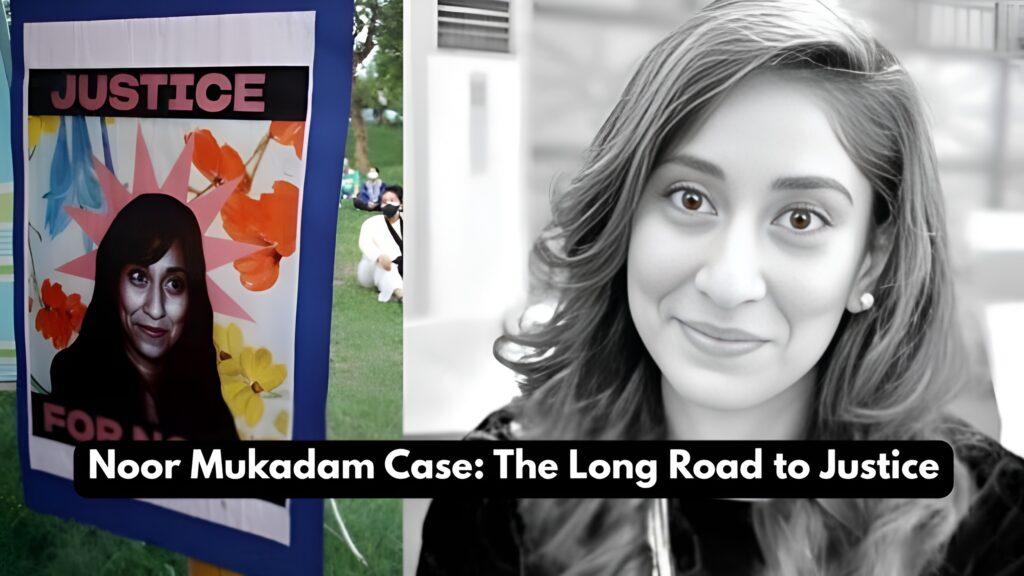
Key Timeline
| Date | Event |
|---|---|
| 18 July 2021 | Noor Mukadam visited Zahir Jaffer’s residence in Islamabad. |
| 20 July 2021 | Police responded to a report of disturbance by a neighbour at the residence, found Noor dead, and arrested Zahir Jaffer at the scene. |
| 2021 | Police completed the investigation and submitted the challan. |
| 24 February 2022 | The District and Sessions Court convicted Zahir Jaffer and sentenced him to death for murder. |
| 13 March 2023 | The Islamabad High Court upheld the conviction. |
| 20 May 2025 | The Supreme Court upheld the murder conviction and death sentence while reducing the punishment for the rape conviction to life imprisonment. |
| 4 June 2026 | The Supreme Court dismissed the review petition, leaving the murder conviction and death sentence unchanged. |
Why the Case Resonated Across Pakistan
The Noor Mukadam case became far more than a criminal prosecution. It sparked nationwide conversations about women’s safety, privilege, accountability, and the effectiveness of Pakistan’s justice system. Public confidence in the investigation was strengthened by the immediate arrest of the accused and the extensive use of CCTV footage, forensic science, and digital evidence, which prosecutors argued established a clear sequence of events.
The proceedings also demonstrated the growing importance of evidence-based investigations in Pakistan. Rather than relying on witness testimony alone, investigators built their case using multiple forms of corroborating evidence, including DNA analysis, medical reports, electronic records, and crime scene documentation. As the case progressed through the courts, it became a benchmark against which future high-profile criminal investigations would be measured.
Social Media’s Role in Noor’s Case: The Negatives and Positives
Social media was a double-edged sword in the Noor Mukadam case. On the positive side, platforms such as X (formerly Twitter), Facebook, Instagram, YouTube, and Reddit transformed the case into a nationwide movement through the hashtags #JusticeForNoor and #WeWillNotForgetYouNoor. The sustained online campaign kept the case in the public eye, encouraged extensive media coverage, and increased public scrutiny of the investigation and court proceedings. Activists, journalists, lawyers, and women’s rights organisations used social media to challenge victim-blaming narratives, highlight gender-based violence, and demand accountability, helping to sustain pressure until the case reached its conclusion in the Supreme Court. Several recent academic studies have identified #JusticeForNoor as a significant example of digital activism in Pakistan.
However, social media also exposed its darker side. Alongside legitimate public debate, platforms became a source of misinformation, speculation, and sensationalism, with unverified claims, leaked material, and intrusive commentary spreading rapidly. Some users engaged in victim-blaming, questioned Noor’s character, or circulated rumours that were never established in court. Discussions on Reddit and other forums reflected both genuine public concern and polarised opinions, illustrating how anonymity can amplify empathy as well as hostility.
Researchers examining online discourse around the case concluded that while social media played a vital role in mobilising support for justice, it also intensified misinformation, misogyny, and emotional distress for Noor’s family, demonstrating the complex influence of digital platforms on high-profile criminal cases.
In Conclusion…
Five years after Noor Mukadam’s death, the legal battle has reached its conclusion, but the conversations it sparked continue. The case changed the way many Pakistanis viewed criminal investigations, digital evidence, and public accountability. It also showed the influence of responsible journalism, public engagement, and sustained legal scrutiny in high-profile cases. Today, the Noor Mukadam case stands not only as a landmark criminal prosecution but also as a reminder that justice depends on evidence, transparency, and the consistent application of the law.