By Injila Baqir Zeeshan
Meta has suffered a landmark legal defeat in New Mexico in a case that could have much wider implications for how social media platforms are held responsible for harms associated with their products.
The case, brought by the State of New Mexico against Meta Platforms, focused on Facebook and Instagram about the risks to children and teenagers. It began in December 2023, when New Mexico Attorney General Raúl Torrez sued Meta, its subsidiaries and CEO Mark Zuckerberg following an undercover investigation into child sexual exploitation and other alleged harms on the company’s platforms.
At the heart of the case is a question that has become most important in debates around digital platforms: Should technology companies only be responsible for harmful content posted by users, or can they also be held accountable for the way their platforms are designed and operated?
The New Mexico rulings push that debate firmly towards the second question.
The case
New Mexico alleged that Meta had failed to protect children adequately from sexual exploitation, online solicitation and other harms, while also designing Facebook and Instagram in ways that encouraged excessive or compulsive use. The state also accused Meta of misleading consumers about the safety of its platforms.
The importance of the case lies partly in its focus on the platform environment itself. Rather than treating harmful online experiences solely as the result of individual users or predators, New Mexico argued that product design, recommendation systems and safety practices could contribute to the conditions in which harm occurs.
The undercover investigation
The original complaint followed an undercover investigation in which state investigators created decoy accounts posing as children aged 14 and under. According to the New Mexico Department of Justice, investigators documented sexually explicit recommendations, approaches from adult users and other forms of predatory activity. Meta disputed the allegations and has consistently defended its record on youth safety.
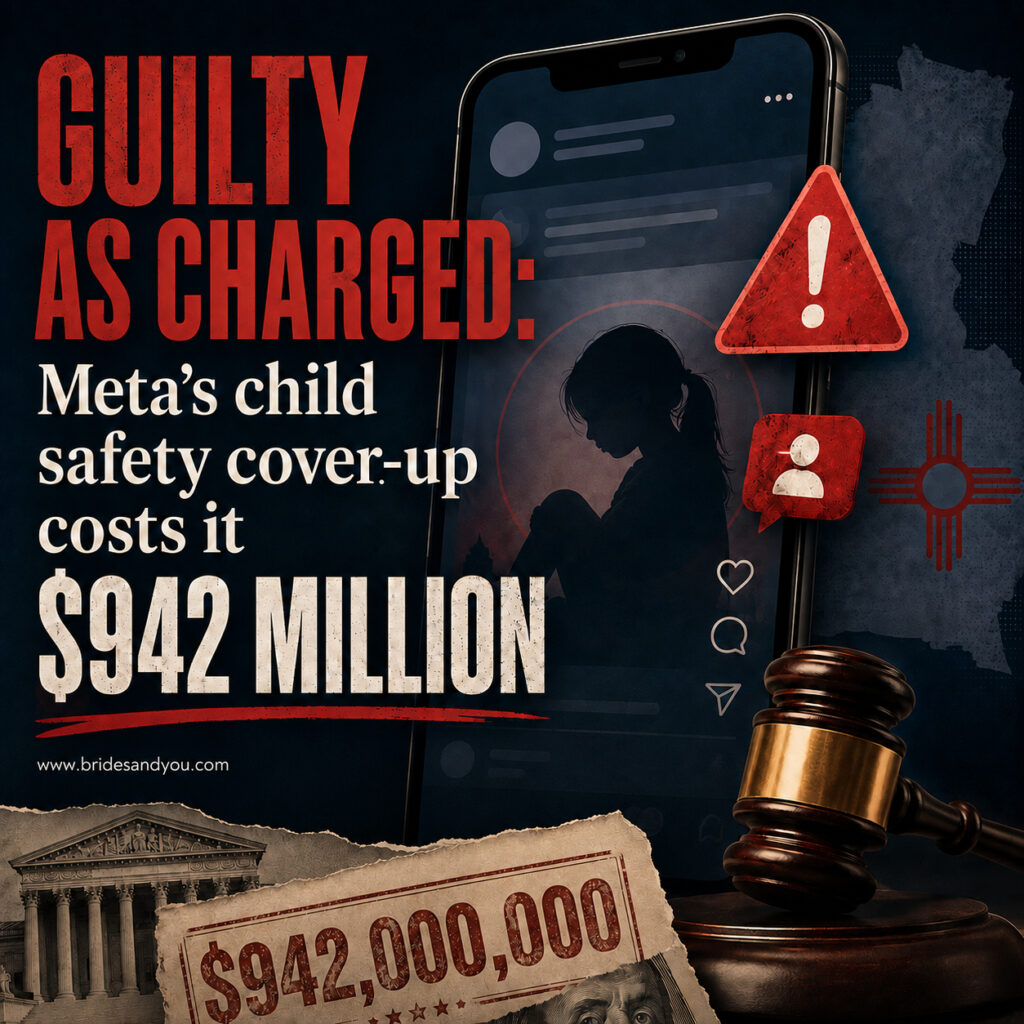
Meta faces a $942 million bill
On 24 March 2026, a New Mexico jury found Meta liable on both of the state’s claims under the New Mexico Unfair Practices Act. The jury found 75,000 violations and imposed the statutory maximum civil penalty of $5,000 per violation, producing a total of $375 million in civil penalties.
The case then moved to a second, non-jury phase before Judge Bryan Biedscheid. On 6 August 2026, the judge ruled that Meta had created a public nuisance in New Mexico and ordered the company to pay an additional $567 million into a fund intended to address youth mental-health prevention, treatment and related harms.
Combined with the earlier $375 million jury award, Meta’s financial exposure in the New Mexico case reached approximately $942 million.
Meta has denied wrongdoing and said it will appeal the rulings.
Meta must also change how its platforms operate
The August ruling did more than impose a financial remedy. It ordered Meta to make substantial changes for Facebook and Instagram users in New Mexico under a court-supervised decree lasting five years.
Among the measures reported in the judgment are the following:
- More stringent age-assurance measures.
- Limits on the amount of time minors may spend on the platforms.
- Restrictions on push notifications.
- Tighter controls on adult contact with minors.
- Stronger protections relating to suspected nude images.
- Safeguards preventing sexualised interactions between minors and Meta’s AI chatbots.
According to Reuters, users under 18 are to be limited to no more than 90 hours per month on Facebook and Instagram, while certain notifications are to be disabled overnight and during school hours.
Not every remedy granted by the judge
An important thing to note here is that the judge did not grant every remedy New Mexico requested. He stopped short of ordering some proposed changes to algorithms and features such as infinite scroll and autoplay, citing concerns that those requirements could conflict with the First Amendment, Section 230 and Meta’s legitimate business interests.
The New Mexico Department of Justice has also acknowledged that the court stopped short of imposing the kind of hard age-verification regime the state had sought.
That makes the judgment more nuanced than a simple order to redesign the platforms wholesale. Nevertheless, it represents unusually direct judicial intervention into the operation and governance of a major social-media service.
Section 230’s importance
One of the most important legal aspects of the case concerns Section 230 of the Communications Decency Act. It normally protects social media companies from being legally responsible for things their users post. Meta therefore argued, in effect, “If users posted harmful material, we cannot be blamed for that content.”
The judge said that protection did not automatically apply here, because New Mexico was also blaming Meta itself, specifically, the way Facebook and Instagram were designed, including their features and systems.
So the key distinction is:
Harmful content posted by users → Meta may have Section 230 protection.
Harm caused or encouraged by Meta’s own platform design → Section 230 may not protect Meta.
That is why this part of the case is important: the court was looking not only at what people posted, but also at how Meta designed the environment in which those interactions happened.
But the ruling should not be read as eliminating Section 230 protection altogether. As noted above, the judge declined to impose some of New Mexico’s requested design changes partly because of Section 230 and First Amendment concerns.
What’s most important to note here is this: Section 230 did not give Meta blanket immunity from claims directed at its own product design and conduct.
The shift: harmful content to harmful design
For much of the history of social-media regulation, public debate has focused primarily on content: misinformation, hate speech, pornography, harassment, extremist material and other harmful posts.
Increasingly, however, regulators, researchers and courts are asking another question:
What role does the architecture of the platform play in producing, encouraging or amplifying harm?
Social-media platforms are not simply empty spaces in which people communicate. Their interfaces, recommendation systems, notifications, like buttons, follower counts and engagement mechanisms shape what users see and what actions are encouraged.
This is where the New Mexico case becomes particularly interesting from a digital-media perspective. The legal argument moves beyond the question of what content was posted and towards the question of how the technological environment itself was designed.
A question of affordances affecting behaviours
In digital media studies, one useful concept for understanding this issue is affordances: the possibilities for action that a technology makes available, easier or more likely.
A “like” button allows users to signal approval. A recommendation system can encourage continued viewing. Push notifications prompt users to return to an app. Public follower or like counts turn popularity and attention into visible metrics.
These features do not determine behaviour, but they can influence it.
The New Mexico case therefore raises a broader question: if particular technological affordances are deliberately designed to increase engagement, to what extent should companies be held responsible when those same features contribute to foreseeable harms?
Platform governance and algorithmic accountability
The case also illustrates the growing importance of platform governance.
For years, companies such as Meta have largely established the rules, technical systems and enforcement mechanisms governing their own platforms. They determine how content is moderated, how recommendation systems operate, what data is collected and which safety features are built into their products.
The New Mexico judgment demonstrates how courts can intervene in some of those choices. The ruling does not simply concern whether particular posts should have been removed. It reaches aspects of how the platform operates for younger users.
Closely connected to this is algorithmic accountability. If recommendation or engagement systems contribute to harmful outcomes, pressure is likely to grow for companies to explain those systems, assess their risks and demonstrate that meaningful safeguards exist.
Meta and Google lose mental health case in Los Angeles
The New Mexico decision is not an isolated development.
On 25 March 2026, one day after the New Mexico jury verdict, a Los Angeles jury found Meta and Google liable in a separate case brought by a young woman, Kaley G.M., who said Instagram and YouTube contributed to her depression and anxiety.
The jury awarded $6 million in total damages, allocating 70 percent of the responsibility to Meta and 30 percent to Google. It found Meta negligent in the design and operation of Instagram and concluded that its negligence was a substantial factor in the plaintiff’s harm. Both companies have said they will appeal.
Yet another separate multibillion-dollar settlement by Meta
On 26 August 2026, Meta agreed to pay up to $18 billion over ten years to settle lawsuits brought by nearly all US states over claims that Facebook and Instagram were designed to keep young users engaged, misled the public about risks to children, and improperly handled children’s data. Meta also agreed to new safeguards, including default two-hour daily limits for teenagers, overnight restrictions, age checks, fewer school-hour notifications, and hidden like counts for teens. Meta admitted no wrongdoing. New Mexico and Florida were not part of this settlement.
Taken together, these developments suggest that courts and regulators are increasingly examining the relationship between platform design, commercial incentives, user safety and corporate responsibility.
Major implications for the future of social media
Perhaps the most important lesson from the New Mexico ruling is that the debate around technology regulation is changing.
The central question is no longer simply:
Who created the harmful content?
Increasingly, another question sits alongside it:
Who designed the system through which that content was recommended, amplified, rewarded or monetised?
It does not mean platforms are automatically responsible for every harmful interaction that occurs on their services. Nor does the New Mexico judgment settle the law nationally: it is a state-court ruling, it applies directly to New Mexico, and Meta intends to appeal.
What it does show is a growing willingness to examine digital platforms not merely as neutral containers for user-generated content, but as designed environments whose architecture, incentives and governance can have consequences of their own.
The case is a useful example of how questions relating to digital media, platformisation, algorithms and artificial intelligence that have long been discussed theoretically are now becoming matters of litigation, regulation and public policy.
The architecture of digital platforms is being treated not simply as a technical matter, but as a social, political, legal and ethical one. And that may ultimately prove to be the most important consequence of Meta’s defeat.
Sources
- New Mexico Department of Justice — original lawsuit announcement, 6 December 2023
- New Mexico Department of Justice — jury verdict, 24 March 2026
- New Mexico Department of Justice — final judgment and remedies, 7 August 2026
- Reuters — New Mexico court orders Meta to pay $567 million, 6 August 2026
- Reuters — what the New Mexico ruling requires Meta to change, 7 August 2026
- Reuters — Los Angeles verdict against Meta and Google, 25 March 2026
- Reuters — wider US settlement and current litigation context, 26 August 2026
AI disclosure: This article was researched with the assistance of ChatGPT (OpenAI) with the final draft, review and editing by Injila Baqir Zeeshan. Legal and factual claims were checked against the New Mexico Department of Justice and Reuters sources listed above.
Leave a Reply